Simple Doesn't Mean Basic: What Performance Apparel Buyers Need to Know
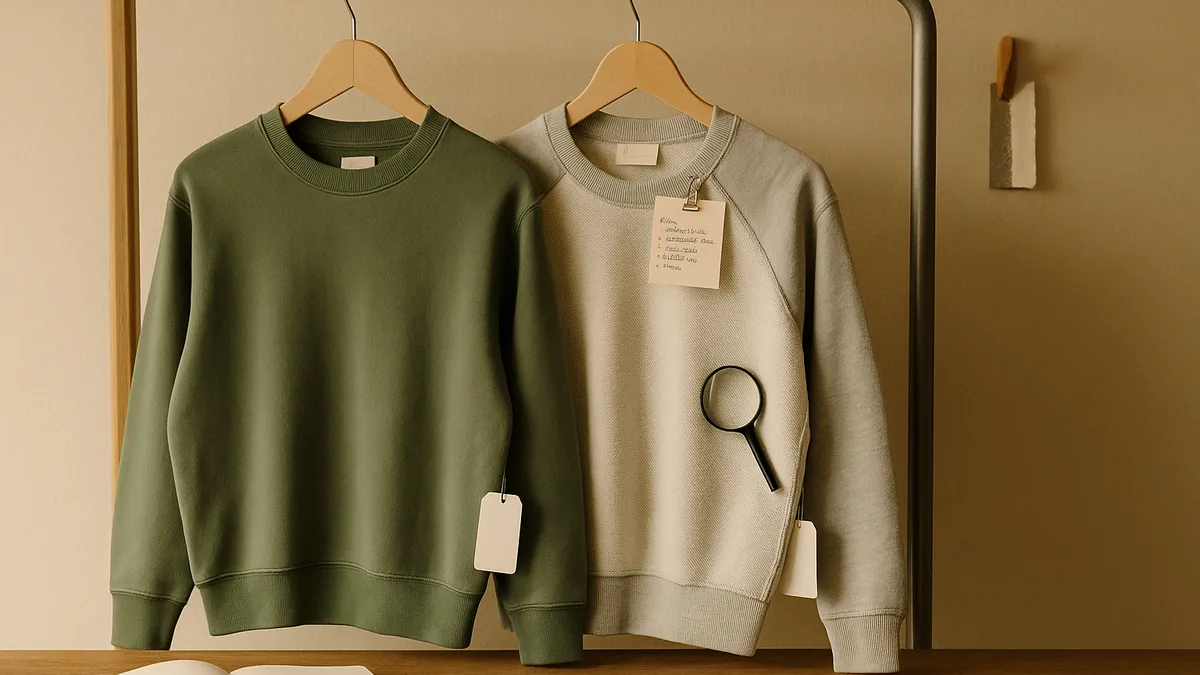
If you've ever picked up a plain-looking training top and wondered whether it was genuinely well-designed or just cheap to make, you're asking exactly the right question. It turns out that 'simple' is one of the most misread words in performance apparel — and understanding what it actually means can save you from paying premium prices for products that don't deliver.
This post breaks down three common confusions around simplicity, explains what genuinely restrained design looks like, and gives you a practical way to evaluate products for yourself.
Isn't Minimalism the Same as Simplicity?
Not quite, and this distinction matters more than it might seem. Minimalism is a visual style — clean lines, muted tones, no unnecessary decoration. Simplicity is about function. A product can look very minimal and still be technically overcomplicated underneath, with bonded seams or proprietary fabrics that add cost without adding performance. Equally, a product with visible stitching and a few functional pockets can be genuinely simple if every element present has a clear, purposeful role.
When buyers conflate the two, they tend to gravitate toward products that look restrained but are actually complex for complexity's sake — and overlook conventionally styled pieces that are precisely engineered for their purpose. The visual impression and the functional reality don't always match.
How Do Brands Use 'Simple' as a Marketing Tool?
This is where things get a little uncomfortable. Brands operating at volume have a financial incentive to present stripped-back products as deliberate design decisions, even when the real driver is reducing manufacturing costs. A basic training tee is inexpensive to produce. Framing it as 'simple by design, functional by intent' is a much easier sell than admitting it's the budget option.
Champion is a useful case study here. Its reverse weave construction has real performance history behind it — the design genuinely does reduce shrinkage and improve durability. That heritage is authentic. But across Champion's wider range, the gap between 'designed to be simple' and 'simple because it's cheaper to make that way' isn't always obvious. The brand narrative doesn't always tell you which side of that line a specific product sits on.
The question worth asking with any stripped-back product is this: do the missing components benefit the wearer, or the manufacturer? Fewer seams that reduce chafing and improve movement serve the wearer. Fewer components that cut material costs without any functional payoff serve the manufacturer. Both can produce something that looks identical on a hanger.
What Does Genuine Design Restraint Actually Look Like?
When simplicity is a real engineering choice rather than an aesthetic or a cost decision, a few things become apparent.
Fabric selection becomes far more critical. If a garment carries no extra features — no ventilation panels, no articulated construction, no zip pockets — the fabric itself has to do all the heavy lifting. The weight, stretch recovery, moisture management and durability of the material become the primary performance factors. A simple product built on a poorly chosen fabric is just a poor product. A simple product built on a precisely specified one can be exceptional.
Construction details also matter more, not less, in restrained designs. Seam placement on a plain training short determines whether it causes friction under load. A hem that rolls after a few washes is a minor annoyance in a feature-heavy piece; in a stripped-back one, it's the defining flaw because there's nothing else to compensate.
New Balance has produced pieces in its technical training range that demonstrate this well. When the brand gets it right, the absence of excess detail is clearly intentional — proportions are suited to movement, fabric weights are appropriate for specific training contexts, and the construction holds up over sustained use without announcing itself. It doesn't always reach this standard across its full catalogue, but when it does, the difference is noticeable.
Why Do Big Brands Keep Adding Complexity?
Large sportswear brands face structural pressure to differentiate new seasonal ranges from previous ones. Marketing cycles require updated technology narratives. A training short that performed well with two fabric panels tends to become a three or four-panel product the following year — not because training demands have changed, but because the product needs to look new.
Nike is the clearest example of this at scale. Its genuine engineering capability isn't in doubt, but across its volume training range, the complexity of many products outpaces what recreational athletes actually need. A gym-goer purchasing a heavily featured base layer is often paying for specifications they'll never meaningfully use.
How to Evaluate a Product Yourself
Brand narrative is not a reliable guide here, so it helps to build your own framework. Start by identifying the product's stated purpose — what training context is it designed for, and what problem is it solving? Then look at whether the materials and construction decisions connect logically to those answers.
A base layer with a specific fabric weight, flatlock seams and a close fit designed for high-output training has a coherent design logic. The same garment with added ventilation panels and a chest zip may or may not be more functional — it depends entirely on whether those additions address a real need or are simply there to justify the price point.
Reading the construction rather than the marketing language tends to be the most reliable method. Simplicity that genuinely serves the wearer shows up in how materials have been chosen and how each component relates to the others. Complexity that serves no-one but the brand tends to show up in features that can't be clearly mapped to a training benefit.
- Minimalism is visual; simplicity is functional — they are not the same thing.
- Brands can and do present cost-saving decisions as design choices. Read products critically.
- Ask whether fewer components benefit the wearer or the manufacturer.
- In genuinely restrained designs, fabric quality becomes the primary performance factor.
- Evaluate construction decisions against the product's stated purpose, not its marketing language.
Simplicity done well is actually one of the harder things to achieve in apparel design — and one of the easier things to fake. Once you know what to look for, the difference becomes much clearer, and your purchasing decisions tend to get a lot sharper as a result.
Labels: performance apparel, product review, design, training gear, consumer advice, sportswear, buying guide
Read More
Read the original article and more from Review-It:
- Read the full article on Review-It
- The Best Under-Gi Base Layers Reviewed
- Review-It — Independent, Evidence-Based Reviews
- Our Review Methodology
- Review-It on Facebook
- Review-It on Threads
- X (Twitter)
- Threads
- Bluesky
- YouTube Community
About Review-It
This article was produced by Review-It, an independent UK review site. Our verdicts follow a documented methodology, we accept no payment for coverage, and every correction is recorded publicly.


Comments
Post a Comment